


High-net-worth individuals and corporate executives in Atlanta face a 14% increase in sophisticated security threats, yet many still rely on outdated protection models that leave critical vulnerabilities exposed. Traditional bodyguard services focus on visible deterrence and reactive response, but modern threats require proactive, intelligence-driven strategies that prevent incidents before they materialize. Close protection offers a comprehensive security discipline specifically designed for high-risk clients who need discreet, strategic protection across all aspects of their daily lives. This guide explains what close protection entails, how it differs fundamentally from conventional bodyguard services, and why Atlanta’s unique threat landscape makes specialized close protection essential for executives and affluent residents seeking reliable personal safety.
Table of Contents
- Key takeaways
- Understanding close protection: definition and core principles
- How close protection differs from traditional bodyguard services
- Core strategies and technologies in modern close protection
- Addressing specific risks for Atlanta’s high-net-worth individuals and executives
- Explore specialized close protection services in Atlanta
- Frequently asked questions
Key Takeaways
| Point | Details |
|---|---|
| Proactive discreet protection | Close protection emphasizes prevention through advance planning, risk assessments, route planning, and coordinated team formations. |
| Discretion with technology | Agents blend into environments while leveraging GPS tracking and surveillance detection to protect the client. |
| Atlanta tailored threat response | Atlanta demands locally informed teams that can adapt to traffic patterns and high profile events. |
| Prevention over reaction | Close protection is proactive and strategic rather than reactive after threats emerge. |
Understanding close protection: definition and core principles
Close protection, also known as executive protection, is a professional security discipline providing discreet personal protection focusing on proactive threat prevention rather than reactive response. Unlike conventional security approaches that wait for threats to emerge, close protection operates on anticipation and strategic planning to eliminate risks before they materialize. The discipline serves high-risk individuals including corporate executives, celebrities, political figures, and high-net-worth families who face elevated security concerns due to their public profiles or wealth.
The goal of close protection extends beyond physical presence. It encompasses comprehensive safety through meticulous advance work, continuous environmental assessment, and adaptive security postures that respond to evolving threat landscapes. Core methodologies include advance work, risk assessments, route planning, protective formations, surveillance detection, layered security, behavioral analysis, and technology integration to create multiple defensive layers around the client.
Key operational principles that define effective close protection include:
- Strategic advance planning that maps venues, identifies exits, coordinates with local authorities, and establishes emergency protocols before client arrival
- Comprehensive risk assessments evaluating potential threats based on client profile, location, current events, and intelligence gathering
- Multiple protective formations providing 360-degree coverage through coordinated team positioning
- Behavioral analysis training enabling agents to identify suspicious patterns, body language cues, and pre-attack indicators
- Technology integration using GPS tracking for real-time location monitoring and TSCM (Technical Surveillance Counter Measures) to detect hidden surveillance devices
Discretion remains paramount in close protection operations. Agents blend seamlessly into environments, avoiding conspicuous displays that draw attention or disrupt client lifestyle. This approach proves essential for Atlanta’s social and business settings where executive protection services must maintain client privacy while ensuring comprehensive safety. The combination of invisible vigilance and strategic positioning allows clients to conduct business, attend events, and travel without feeling restricted by security presence.
Atlanta’s unique challenges, including complex traffic patterns, diverse threat vectors, and high-profile event schedules, require close protection teams with specialized local knowledge and adaptive capabilities. Teams must navigate congested highways, anticipate route delays, and maintain protective postures across varied environments from corporate boardrooms to public venues.
How close protection differs from traditional bodyguard services
The distinction between close protection and traditional bodyguard services centers on fundamental operational philosophy. Close protection is proactive, strategic, team-based, and discreet, focusing on prevention, while bodyguards typically operate reactively, individually, and visibly with emphasis on deterrence and response. This difference profoundly impacts the quality and comprehensiveness of protection delivered to high-risk clients.
Traditional bodyguards function primarily as reactive shields. They position themselves visibly near the client, relying on physical presence to deter potential threats through intimidation. When incidents occur, bodyguards respond with defensive or evasive actions. This model works for basic deterrence but leaves significant gaps in comprehensive threat management. A solo bodyguard cannot simultaneously monitor multiple threat vectors, conduct advance reconnaissance, or maintain protective formations during movement.
Close protection offers better ongoing, low-profile safety for high-profile clients during events and travel through coordinated team operations. CP teams work in formations that provide complete perimeter coverage, with designated roles including advance agents who scout locations, surveillance detection specialists who identify potential threats, and drivers trained in evasive maneuvers. This layered approach ensures no single point of failure compromises client safety.
| Feature | Traditional Bodyguard | Close Protection |
|---|---|---|
| Approach | Reactive response | Proactive prevention |
| Team structure | Individual or small pair | Coordinated multi-agent teams |
| Visibility | Conspicuous deterrence | Discreet blending |
| Planning | Minimal advance work | Extensive reconnaissance |
| Technology | Basic communication | GPS, TSCM, surveillance detection |
| Threat management | Physical intervention | Strategic threat elimination |
Discretion versus visibility represents another critical distinction. Close protection professionals embody the “Silent Professional” ethos, operating invisibly within client environments. They dress appropriately for settings, avoid drawing attention, and maintain protective postures without disrupting client activities. This approach proves essential for executives attending business meetings, social events, or family gatherings where overt security presence would be inappropriate or counterproductive.
Scenarios where close protection’s strategic approach excels include:
- International travel requiring coordination with foreign security services and navigation of unfamiliar threat landscapes
- High-profile events with multiple entry points, crowd dynamics, and potential protest activity
- Complex Atlanta traffic situations demanding real-time route adjustments and backup planning
- Extended protection assignments requiring sustainable operations without client lifestyle disruption
- Multi-location days involving office, meetings, events, and residential transitions
Pro Tip: When evaluating security providers, assess their ability to conduct thorough advance work and deploy coordinated teams rather than focusing solely on individual agent credentials. K-Lock Security LP emphasizes team-based operations that provide comprehensive coverage across all client activities.
Core strategies and technologies in modern close protection
Modern close protection integrates sophisticated strategies and technologies to create multiple defensive layers around clients. Advance planning minimizes exposure and surveillance detection is critical to identifying risks early before they escalate into active threats. These methodologies combine human expertise with technological tools to deliver superior protection outcomes.

The layered security approach begins with comprehensive advance work. Teams visit venues days or weeks before client arrival, mapping layouts, identifying vulnerabilities, establishing emergency exits, and coordinating with local law enforcement. This preparation allows agents to anticipate potential threats and develop contingency plans for various scenarios. Risk evaluation assesses the threat level based on client profile, location history, current events, and intelligence sources.
Route planning forms a critical component of transit security. Core methodologies include advance planning, risk assessments, route planning with contingencies, and various protective formations ensuring 360-degree coverage. Teams identify primary routes, alternate routes, and emergency routes for every journey. In Atlanta’s complex traffic environment, this planning accounts for rush hour congestion, construction zones, and potential choke points where vehicles become vulnerable.
Protective formations provide tactical advantages through coordinated positioning:
- Box formation places agents at four corners around the client, ideal for open environments with 360-degree threat potential
- Diamond formation positions one agent forward, two on flanks, and one rear, effective for moving through crowds
- Wedge formation concentrates agents forward to clear paths through dense crowds or hostile environments
- Linear formation aligns agents beside the client, suitable for narrow corridors or controlled environments
Key technologies enhancing modern close protection include:
- GPS tracking systems providing real-time location monitoring of client vehicles and agent positions
- TSCM (Technical Surveillance Counter Measures) equipment detecting hidden cameras, audio bugs, and GPS trackers
- Encrypted communication systems enabling secure team coordination without interception risk
- Threat intelligence databases accessing current information on criminal activity, terrorism, and regional risks
- Biometric access controls securing residential and office environments
Behavioral analysis techniques train agents to identify pre-attack indicators through observation of body language, movement patterns, and environmental anomalies. Agents learn to recognize surveillance activity, assess crowd behavior for hostile intent, and distinguish genuine threats from false alarms. This human intelligence component remains irreplaceable despite technological advances.
“Technology amplifies human capability but never replaces experience and situational awareness. The most effective close protection integrates cutting-edge tools with agents who possess deep tactical knowledge and adaptive thinking.”
Pro Tip: Effective protection requires balancing technology with human judgment. Over-reliance on electronic systems creates vulnerabilities when equipment fails or adversaries employ countermeasures. The best security teams use technology to enhance awareness while maintaining core tactical skills. Professional close protection training emphasizes this integrated approach.
Addressing specific risks for Atlanta’s high-net-worth individuals and executives
Atlanta’s unique threat landscape presents specific challenges for high-net-worth individuals and corporate executives requiring tailored close protection strategies. Atlanta saw a 14% rise in sophisticated threats and complex traffic conditions complicate protective operations, making generic security approaches insufficient for comprehensive protection.
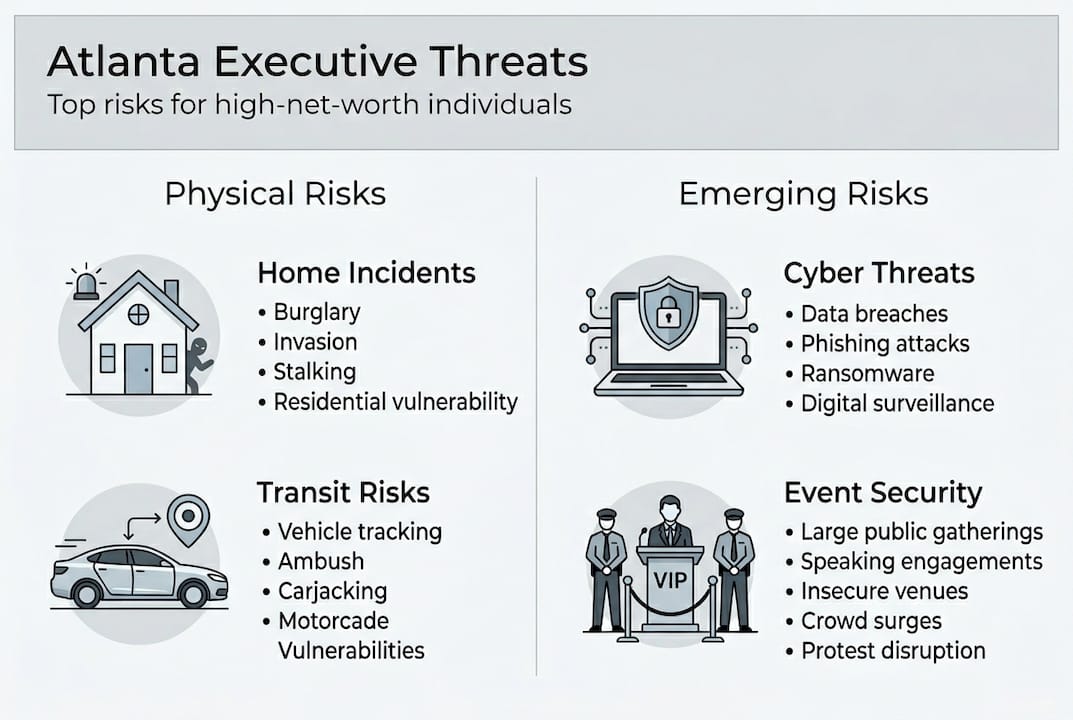
Recent data reveals concerning trends in executive-targeted incidents:
| Year | Total Incidents | Home/Residential | Transit/Vehicle | Digital/Cyber | Event/Public |
|---|---|---|---|---|---|
| 2024 | 847 | 312 | 298 | 187 | 50 |
| 2025 | 966 | 356 | 340 | 215 | 55 |
| 2026 (projected) | 1,101 | 406 | 388 | 245 | 62 |
72% of attacks targeting HNWIs happen near home or during transit, highlighting residential vulnerability as the primary security concern. This statistic underscores why close protection must extend beyond workplace security to encompass home environments, commute routes, and personal travel. Criminals target predictable patterns, exploiting routine departure times, regular routes, and unsecured residential perimeters.
Atlanta’s traffic complexity amplifies transit vulnerabilities. The metropolitan area’s highway system creates numerous choke points where vehicles become stationary targets during congestion. Close protection teams must develop contingency routes accounting for real-time traffic conditions, construction updates, and potential threat scenarios. Teams coordinate with drivers trained in evasive maneuvers and defensive driving techniques specific to urban environments.
Multi-threat concerns facing Atlanta executives include:
- Financial crimes including kidnapping for ransom, extortion, and identity theft targeting wealthy individuals
- Digital doxxing exposing personal information, family details, and daily routines online
- Politically motivated threats during high-profile events or controversial business decisions
- Opportunistic crimes exploiting visible wealth displays or predictable behavior patterns
- Corporate espionage targeting intellectual property, merger negotiations, or strategic planning
Practical actions executives can take to enhance protection effectiveness:
- Secure home perimeters with integrated alarm systems, surveillance cameras, and controlled access points
- Vary daily routines including departure times, routes, and activity patterns to prevent predictability
- Coordinate closely with close protection teams, sharing schedule changes and potential threat information
- Implement digital security measures including VPNs, encrypted communications, and social media privacy controls
- Conduct regular security assessments evaluating vulnerabilities across residential, transit, and workplace environments
Atlanta security services must adapt to these localized threats through customized protection plans that address specific client risk profiles. Generic security templates fail to account for individual vulnerabilities, daily patterns, or unique threat exposures that vary significantly among high-net-worth individuals.
Explore specialized close protection services in Atlanta
Understanding close protection principles provides the foundation, but implementing effective security requires partnering with experienced providers who deliver tailored solutions. K-Lock Security offers comprehensive close protection services specifically designed for Atlanta’s high-net-worth individuals and corporate executives facing sophisticated security challenges.
Our close protection services integrate the strategies and technologies discussed throughout this guide into practical, discreet security solutions. We provide both armed and unarmed protection tailored to client preferences and threat levels. Services encompass personal protection for daily activities, event security for high-profile gatherings, travel risk management for domestic and international trips, and customized security planning addressing specific vulnerabilities.
Key benefits of partnering with K-Lock Security LP include:
- Experienced protection teams with extensive tactical training and real-world operational experience
- Discreet professional approach maintaining client privacy while ensuring comprehensive safety
- Technology integration using GPS tracking, TSCM equipment, and encrypted communications
- Local Atlanta knowledge understanding regional threat patterns, traffic dynamics, and law enforcement coordination
- Scalable team deployment adapting to changing security needs and threat levels
Pro Tip: Choosing a provider with deep local insights and the ability to deploy coordinated teams makes all the difference for effective protection. Generic national providers often lack the regional expertise necessary to navigate Atlanta’s specific security challenges.
We encourage executives and high-net-worth individuals to schedule personalized security consultations. Our team conducts comprehensive risk assessments, evaluates current vulnerabilities, and develops customized protection plans aligned with your lifestyle and security requirements. Contact K-Lock Executive Protections today to discuss how our close protection services can secure your safety and provide the peace of mind you deserve.
Frequently asked questions
What exactly is close protection and who needs it?
Close protection is a specialized security discipline providing discreet, proactive personal protection for high-risk individuals through strategic planning and threat prevention. Corporate executives, high-net-worth families, celebrities, and political figures facing elevated security risks due to wealth, public profile, or business activities benefit most from professional close protection services.
How much does close protection cost in Atlanta?
Close protection costs vary based on threat level, team size, duration, and service complexity. Basic single-agent protection typically ranges from $50 to $100 per hour, while comprehensive multi-agent teams for high-risk clients can cost $200 to $500 per hour or more. Most providers offer customized packages based on specific security needs and budget considerations.
What training do close protection agents receive?
Professional close protection agents complete extensive training in tactical skills, threat assessment, defensive driving, first aid, firearms proficiency, surveillance detection, and behavioral analysis. Many agents have military or law enforcement backgrounds and pursue specialized certifications through recognized security training programs. Ongoing training ensures agents maintain current skills and adapt to evolving threats.
Can close protection services be discreet?
Yes, discretion is a fundamental principle of professional close protection. Agents dress appropriately for client environments, avoid conspicuous displays, and blend seamlessly into social and business settings. The goal is maintaining comprehensive security without disrupting client lifestyle or drawing unwanted attention. This discreet approach distinguishes close protection from traditional visible bodyguard services.
How quickly can close protection services be deployed?
Deployment timelines depend on threat urgency and service complexity. For immediate threats, experienced providers can deploy basic protection within hours. Comprehensive protection requiring advance reconnaissance, team coordination, and customized planning typically requires 24 to 72 hours for optimal implementation. Emergency response capabilities ensure rapid deployment when situations demand immediate action.
