


When seconds count, emergency response security teams arrive on scene in under five minutes, delivering specialized crisis intervention before public responders can mobilize. For high-net-worth individuals and corporate executives in Atlanta, this ultra-rapid deployment can mean the difference between life and death, or between contained incidents and catastrophic property loss. This guide explains what emergency response security entails, how these specialized teams operate, why response time benchmarks matter critically, and how you can implement tailored protection strategies that safeguard both your personal safety and valuable assets during the most dangerous moments.
Table of Contents
- Key takeaways
- Understanding emergency response security: scope and mechanics
- Step-by-step process of emergency response security operations
- Why rapid response times and bespoke plans matter for HNWIs and executives
- Applying emergency response security: practical considerations for Atlanta executives and HNWIs
- Explore K-Lock’s emergency response security solutions
- Frequently asked questions
Key Takeaways
| Point | Details |
|---|---|
| Ultra rapid arrival | Emergency response security teams mobilize and reach the scene in under five minutes to begin crisis intervention before public responders can arrive. |
| Executive protection focus | Services are tailored for high net worth individuals and corporate executives to prioritize life safety and asset protection. |
| End to end crisis actions | The teams provide early detection, rapid dispatch, on site containment, medical aid, evacuation, and post incident processes. |
| NFPA 1710 benchmarks | Operations are aligned with NFPA 1710 benchmarks to maintain rapid response times and coordinated incident management. |
Understanding emergency response security: scope and mechanics
Emergency response security is a specialized private security service that deploys trained officers rapidly to crisis situations, focusing on scene containment, life safety, evacuation, and bridging the critical gap until public responders arrive. Unlike standard security guard services that provide static protection or routine patrols, emergency response teams maintain constant readiness to mobilize within moments of threat detection. These professionals receive extensive training in crisis intervention, tactical response, medical first aid, and incident command protocols that enable them to manage chaotic scenarios effectively.
Private emergency response security targets response benchmarks aligned with NFPA 1710 standards, aiming for arrival times of less than five minutes from initial alert. This rapid timeline proves essential because the first minutes of any emergency determine outcomes. Whether facing an active threat, home invasion, medical crisis, or natural disaster at a private residence or during executive travel, these teams provide immediate intervention that can save lives and minimize property damage. Their specialized focus distinguishes them from general security personnel who lack the training, equipment, or mandate for emergency crisis management.
The scope of emergency response security encompasses several critical functions. Teams conduct continuous monitoring through integrated alarm systems, CCTV networks, and 24/7 Global Security Operations Center oversight. Upon threat detection, they dispatch specialized officers equipped for the specific emergency type. On arrival, responders establish perimeter control, manage access points, provide immediate medical assistance, coordinate evacuations or shelter-in-place protocols, and maintain scene integrity for law enforcement. This comprehensive approach ensures that high-value clients receive professional protection during the most vulnerable moments, with executive protection services extending beyond routine security into true crisis intervention.
Pro Tip: Request detailed service level agreements specifying guaranteed response times, team qualifications, equipment standards, and escalation protocols. Verify that your provider maintains redundant dispatch capabilities and backup teams to ensure consistent coverage even during simultaneous incidents or staff absences.
Step-by-step process of emergency response security operations
Emergency response security follows a systematic operational framework designed to maximize effectiveness during crisis situations. Understanding these sequential phases helps executives and property owners appreciate the professionalism and coordination required for successful emergency intervention.
-
Early detection and monitoring: Security operations centers maintain 24/7 surveillance through integrated alarm systems, motion sensors, CCTV feeds, and access control monitoring. Advanced systems use artificial intelligence to identify anomalies and potential threats before they escalate. Human analysts review automated alerts to eliminate false positives and assess genuine emergencies requiring immediate response. This continuous vigilance ensures that threats receive attention within seconds of occurrence, not minutes or hours after the fact.
-
Rapid dispatch and mobilization: Upon confirming an emergency, operations centers immediately deploy specialized teams positioned strategically throughout the service area. Dispatchers transmit real-time intelligence about the threat type, location details, known hazards, and client-specific protocols to responding officers. Mobile units receive updates continuously during transit, enabling them to adjust tactics based on evolving situations. This coordinated dispatch process minimizes response time while ensuring teams arrive prepared for the specific emergency they will encounter.
-
On-scene incident command establishment: Responding teams implement Incident Command System protocols immediately upon arrival, designating clear leadership, establishing communication channels, and creating organizational structure for the response effort. Officers secure the perimeter, control access points, and establish safe zones for civilians. They assess the situation systematically, identify immediate threats, and prioritize actions based on life safety first, then property protection. This professional structure prevents chaos and ensures coordinated response even during complex multi-threat scenarios.
-
Medical aid and evacuation coordination: Trained responders provide immediate first aid for injuries, stabilize medical emergencies, and coordinate professional medical transport when required. They execute pre-planned evacuation routes or implement shelter-in-place protocols depending on threat type and environmental conditions. For executives with special needs or mobility limitations, teams follow customized evacuation procedures developed during vulnerability assessments. This medical and evacuation capability often proves lifesaving during the critical minutes before paramedics arrive.
-
Law enforcement and emergency service liaison: Professional security teams maintain direct communication channels with local police, fire departments, and emergency medical services. They provide detailed situation reports, facilitate access for public responders, and coordinate integrated response efforts. This liaison function ensures smooth transitions between private security intervention and public emergency response, preventing duplication of effort or conflicting tactics. Teams brief arriving officers on actions taken, evidence preserved, and ongoing threats requiring attention.
-
Post-incident documentation and analysis: After the immediate crisis resolves, response teams preserve evidence, document the incident timeline, photograph scenes, and prepare comprehensive reports. They conduct debriefings with clients, identify security gaps exposed during the incident, and recommend improvements to prevent recurrence. This analytical phase transforms each emergency into a learning opportunity that strengthens future protection.
Pro Tip: Conduct quarterly tabletop exercises simulating different emergency scenarios with your security provider. These practice sessions reveal gaps in communication protocols, test evacuation procedures, and ensure all parties understand their roles during actual crises. Include household staff, family members, and executive assistants in these exercises for comprehensive preparedness.
Why rapid response times and bespoke plans matter for HNWIs and executives
High-net-worth individuals face unique security challenges that generic protection services cannot adequately address. Customized security planning begins with comprehensive vulnerability assessments that identify specific threats based on wealth profile, public visibility, business activities, family composition, property characteristics, and travel patterns. Practical security plans begin with a vulnerability audit and tailor response blending close protection, rapid security teams, and Global Security Operations Center monitoring, aiming for response times under five minutes.

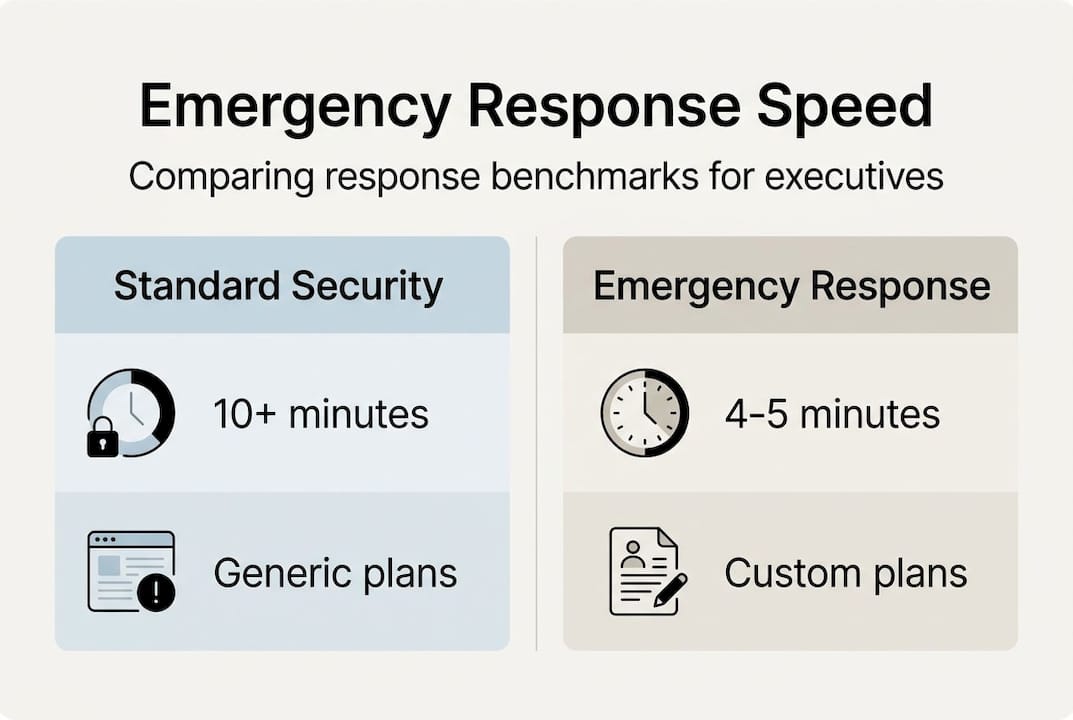
The difference between standard security services and emergency response security becomes clear when comparing response capabilities and service scope:
| Feature | Standard Security | Emergency Response Security |
|---|---|---|
| Response time | 15-30 minutes typical | Less than 5 minutes guaranteed |
| Service focus | Deterrence and observation | Active crisis intervention |
| Training level | Basic security certification | Advanced tactical and medical training |
| Equipment | Communication devices, flashlights | Medical kits, tactical gear, specialized tools |
| Operational model | Reactive to incidents | Proactive monitoring with rapid response |
| Client integration | Generic protocols | Customized plans for specific properties and threats |
The sub-five-minute response benchmark proves critical because most life-threatening situations escalate rapidly. Home invasions, medical emergencies, fires, and violent threats require immediate intervention to prevent fatalities or severe injuries. Property damage accelerates exponentially during the first minutes of fires, floods, or vandalism. By the time public emergency services arrive, often 10 to 20 minutes after initial calls, outcomes may already be determined. Private emergency response security fills this critical gap with specialized teams positioned for ultra-rapid deployment.
Vulnerability audits examine multiple risk dimensions including physical security weaknesses, technological vulnerabilities, personnel threats, and operational exposures. Assessors evaluate property perimeters, access control systems, surveillance coverage, lighting, safe rooms, and emergency exits. They analyze daily routines, travel patterns, social media exposure, and public appearances that might reveal predictable vulnerabilities. This comprehensive analysis informs the integration of executive security planning elements including close protection officers, rapid security teams on standby, 24/7 monitoring centers, and coordinated response protocols.
For Atlanta-based executives and wealthy families, customized planning must account for regional factors including traffic patterns affecting response times, local crime trends, natural disaster risks like severe weather, and the specific threat landscape for high-profile individuals in the metropolitan area. Bespoke home security services integrate seamlessly with existing household operations, providing protection without disrupting daily life or creating fortress-like environments that compromise quality of life.
Pro Tip: Ensure your security plan addresses insider threats from household staff, contractors, or business associates who possess detailed knowledge of your routines, property layouts, and security measures. Background screening, compartmentalized information sharing, and behavioral monitoring programs reduce risks from trusted insiders who might exploit access for kidnapping, theft, or corporate espionage.
Applying emergency response security: practical considerations for Atlanta executives and HNWIs
Implementing effective emergency response security requires understanding both the operational requirements and the specific threat environment facing wealthy individuals in Atlanta. The metropolitan area presents unique security challenges including property crime in affluent neighborhoods, executive targeting for kidnapping or robbery, corporate espionage risks, and natural hazards like tornadoes and severe storms. High-net-worth residents must balance visible security measures that deter threats with discreet protection that maintains privacy and lifestyle quality.
Understanding response time differences across security domains helps prioritize investments and set realistic expectations. Physical emergency response achieves intervention under 5 minutes, vastly faster than cyber incident response which typically requires hours to days for detection and containment:
| Response Type | Detection Time | Initial Response | Full Containment | Recovery |
|---|---|---|---|---|
| Physical emergency | Seconds (automated sensors) | Under 5 minutes | 10-20 minutes | Hours to days |
| Cyber incident | Hours to days (average 207 days) | 2-4 hours after detection | 1-3 days | Weeks to months |
| Medical emergency | Immediate (symptoms) | Under 5 minutes (private) / 8-12 minutes (public EMS) | 20-40 minutes | Variable |
This comparison highlights why physical security response speed matters so critically. Unlike cyber threats where delayed detection still allows for eventual containment, physical emergencies demand immediate intervention because outcomes are determined within minutes.
Executives and HNWIs should follow these practical implementation steps:
- Conduct comprehensive vulnerability assessments covering all properties, regular travel routes, office locations, and family member routines to identify specific exposure points requiring protection.
- Deploy integrated 24/7 monitoring systems combining CCTV surveillance, intrusion detection, environmental sensors, panic buttons, and medical alert capabilities connected to professional security operations centers.
- Contract with providers offering guaranteed rapid deployment by verifying team positioning, backup coverage, response time service level agreements, and performance metrics from actual emergency responses.
- Train household staff and family members on emergency protocols including evacuation procedures, safe room locations, communication methods during crises, and coordination with security teams.
- Establish relationships with executive protection services Atlanta providers who understand local threat landscapes, maintain connections with law enforcement, and can scale services for travel or special events.
- Test systems quarterly through unannounced drills, tabletop exercises, and equipment inspections to ensure readiness when actual emergencies occur.
- Review and update plans annually to account for changing threat environments, family circumstances, new properties, or evolving business risks.
The benefits of properly implemented emergency response security extend beyond immediate crisis intervention. Faster containment of incidents reduces injury severity, property damage, legal liability, and reputational harm. Tailored evacuation plans account for family members with special needs, valuable assets requiring protection, and multiple exit strategies for different threat types. Professional incident management improves outcomes through coordinated response, evidence preservation for insurance claims or prosecution, and systematic documentation that supports legal proceedings when necessary.
For Atlanta executives balancing demanding careers with family safety, emergency response security provides peace of mind that professional protection stands ready to intervene during the most critical moments. This proactive approach to personal security recognizes that prevention and deterrence, while important, cannot eliminate all risks. When emergencies occur despite best efforts, having specialized teams positioned for sub-five-minute response can mean the difference between tragedy and successful crisis resolution.
Explore K-Lock’s emergency response security solutions
Protecting your family, assets, and peace of mind demands more than standard security services. K-Lock Security specializes in rapid deployment emergency response tailored specifically for Atlanta’s high-net-worth individuals and corporate executives. Our armed and unarmed protection officers maintain constant readiness to respond within minutes of any crisis, delivering professional intervention that bridges the critical gap before public emergency services arrive. We design customized security plans based on detailed vulnerability assessments of your properties, routines, and unique threat profile.
Our comprehensive services integrate 24/7 monitoring, tactical response teams, close protection, and coordinated crisis management meeting the sub-five-minute response standards that save lives and protect valuable assets. Whether you require ongoing executive protection, event security for high-profile gatherings, or rapid response capabilities for multiple properties, K-Lock delivers the expertise and professionalism that Atlanta’s most discerning clients demand. Discover how K-Lock executive protections and K-Lock Security LP services can provide the tailored emergency response security your situation requires.
Frequently asked questions
What is emergency response security?
Emergency response security is a specialized private service that deploys highly trained officers to crisis situations within minutes, focusing on immediate life safety, scene containment, medical aid, and asset protection. Unlike standard security guards who provide deterrence through presence, emergency response teams actively intervene during home invasions, medical crises, fires, natural disasters, and violent threats. These services primarily serve high-net-worth individuals and corporate executives who require professional crisis management faster than public emergency services can typically respond.
How fast is the typical emergency response?
Private emergency response security targets arrival times of 4 to 5 minutes from initial alert, significantly faster than typical public emergency response which averages 10 to 20 minutes in many areas. This rapid timeline proves critical because the first minutes of any emergency determine outcomes for life safety and property protection. Teams achieve these speeds through strategic positioning throughout service areas, 24/7 readiness, and direct dispatch from monitoring centers that eliminate delays inherent in public emergency call processing.
What makes security plans effective for high-net-worth individuals?
Effective plans start with thorough vulnerability audits that identify specific threats based on wealth profile, public visibility, family composition, and property characteristics. Successful protection integrates multiple layers including rapid security teams positioned for sub-five-minute response, close protection officers for high-risk situations, and continuous Global Security Operations Center monitoring. Customization proves essential because generic security approaches cannot address the unique exposure points, lifestyle requirements, and threat landscapes facing wealthy individuals and executives.
How does emergency response security differ from regular security services?
Emergency response security focuses exclusively on rapid crisis intervention with guaranteed response times under five minutes, while regular security services typically provide static guard duties, property patrols, or surveillance with response times of 15 to 30 minutes when incidents occur. Emergency response teams receive advanced tactical training, medical certification, and crisis management education that standard security officers lack. The operational model differs fundamentally, with emergency response maintaining constant readiness for immediate deployment versus the reactive approach of traditional security services that respond after incidents have already escalated.
