

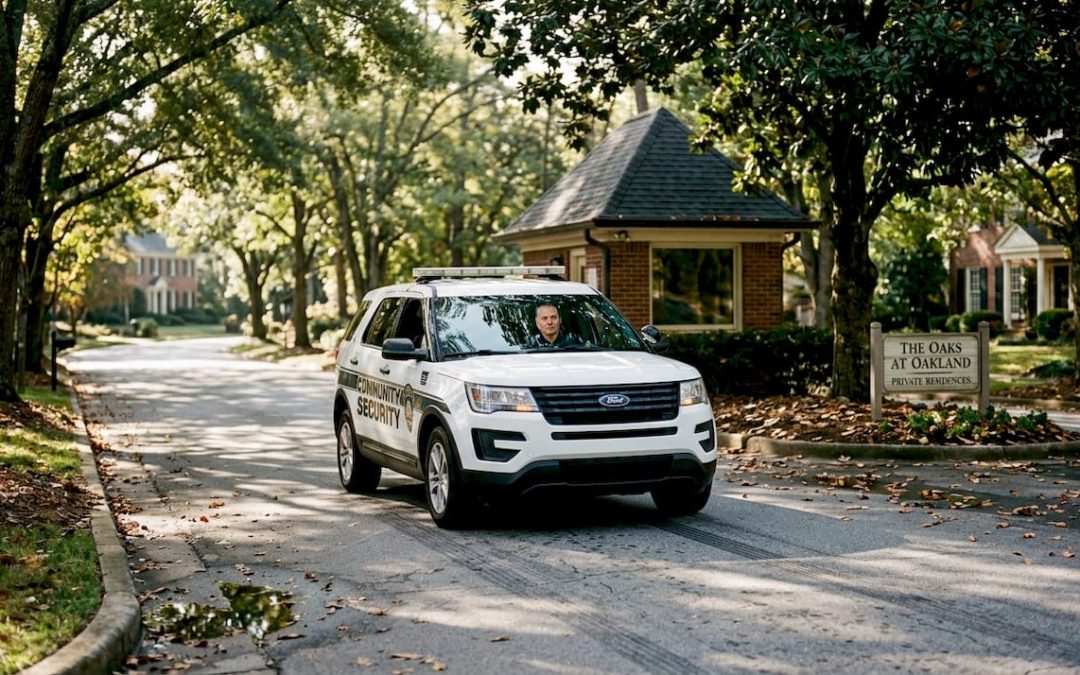
A gate at the entrance of your community looks impressive, but it’s not a security plan. Atlanta’s property crime rate sits at 3,748 per 100,000 residents, which is 91.8% above the national average, and even affluent neighborhoods aren’t fully insulated from risk. The communities that stay safest aren’t the ones with the tallest fences. They’re the ones that treat security as a system, not a single barrier. This guide breaks down exactly what that system looks like, why each layer matters, and how Atlanta’s specific environment shapes the right approach.
Table of Contents
- Understanding the security landscape for Atlanta gated communities
- What makes security effective? The layered approach explained
- Modern access control systems tailored for Atlanta’s needs
- The human factor: Why professional guards matter
- Preparing for edge cases: Tailgating, storms, and emergency access
- How K-Lock can elevate your community’s security
- Frequently asked questions
Key Takeaways
| Point | Details |
|---|---|
| Not just about gates | Effective security for Atlanta gated communities requires more than a gate—multiple layers work best. |
| Integrated technology | Modern, storm-resilient access controls are essential for both convenience and protection. |
| Professional guard value | Trained personnel fill crucial gaps that technology and barriers alone cannot address. |
| Proactive planning matters | Addressing edge cases and reviewing systems regularly keeps residents secure and prepared. |
Understanding the security landscape for Atlanta gated communities
Atlanta’s crime picture is more nuanced than most residents realize. The city’s property crime rate of 3,748 per 100,000 is one of the highest in the country, even as upscale neighborhoods like Buckhead maintain violent crime rates of roughly 257 to 295 per 100,000, which is below the national average. That gap tells an important story: affluent areas are not immune, they’re just differently targeted.
The biggest risk in a well-secured community isn’t always a dramatic breach. It’s complacency. When residents feel safe, they prop gates open, share access codes, and skip reporting suspicious activity. That behavioral drift is where real vulnerabilities develop.
Here’s what the data actually shows about gated communities:
- Gated communities see up to 33% fewer burglaries than non-gated neighborhoods
- Property crime, not violent crime, is the dominant threat in Atlanta’s affluent zones
- Perceived safety often leads to reduced personal vigilance among residents
- HOA-funded security programs vary widely in quality and coverage
- Gaps in access control and patrol schedules are the most commonly exploited weaknesses
Key insight: A 33% reduction in burglary risk is meaningful, but it also means gated communities still experience significant crime. The gate reduces risk. A layered system manages it.
Providers offering armed and unarmed security specifically for Atlanta communities understand this distinction. Generic security doesn’t account for local crime patterns, neighborhood layout, or the behavioral tendencies of residents in high-end communities.
What makes security effective? The layered approach explained
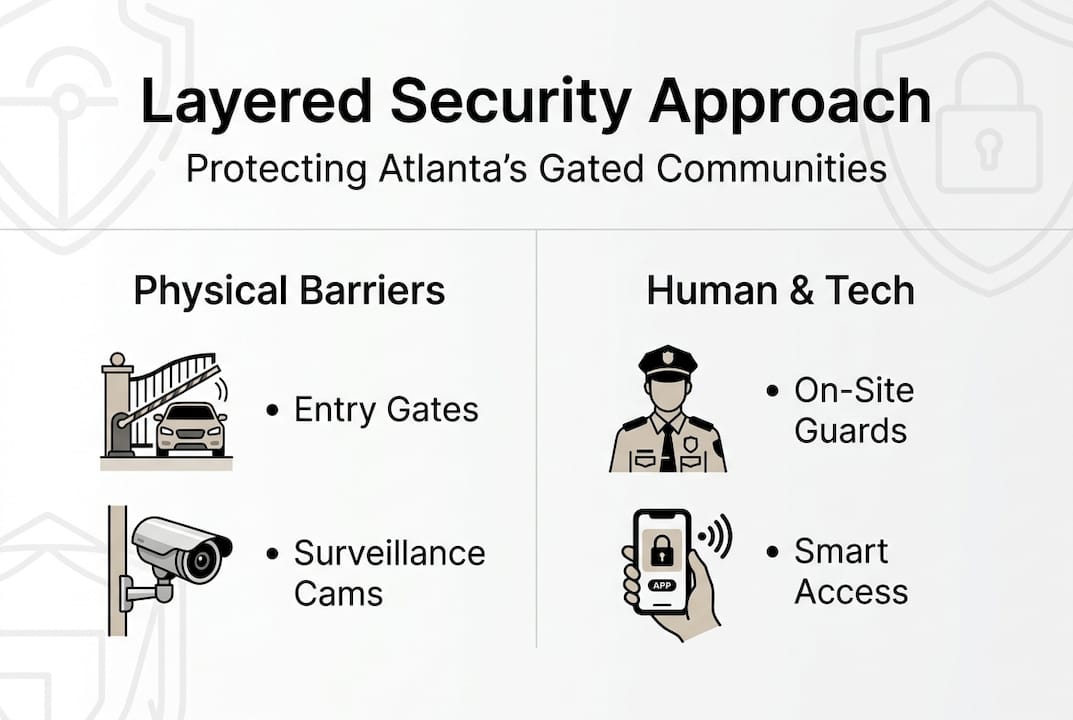
The most effective security programs don’t rely on any single tool. They stack multiple defenses so that if one layer fails, another catches the threat. This is the layered security approach, and it’s the standard used by professional security firms serving gated communities.
The four core layers are:
- Perimeter defense: Fencing, walls, gates, and lighting that define and protect the boundary
- Access control: Systems that verify who enters and exits, from key fobs to biometric readers
- Surveillance: CCTV cameras, motion sensors, and monitoring systems that create a visual record
- Human presence: Trained guards, roving patrols, and manned entry points that respond in real time
Here’s how single-layer security compares to a multi-layered approach:
| Security element | Single-layer only | Multi-layered system |
|---|---|---|
| Gate with no guard | Easily bypassed by tailgating | Backed by camera and patrol response |
| CCTV with no response | Records incidents, doesn’t prevent them | Monitored and linked to guard dispatch |
| Guards with no tech | Limited coverage area | Supported by cameras and access logs |
| Access control alone | Vulnerable to power outages | Backed by cellular backup and manual override |
| Visitor management | Informal, inconsistent | Logged, verified, and audited |
For package storage and delivery security, layered systems also reduce theft at entry points, a growing concern in high-density gated communities.
Pro Tip: Schedule a formal security assessment at least once a year. Technology ages, patrol routes become predictable, and resident habits shift. A fresh review catches gaps before they become incidents.
The importance of trained personnel within this layered system cannot be overstated. Technology creates structure. People create judgment.
Modern access control systems tailored for Atlanta’s needs
Access control has evolved well beyond the simple keypad at the gate. Today’s systems give property managers real-time visibility, remote control, and detailed entry logs. For Atlanta communities specifically, one feature matters more than most: storm resilience.
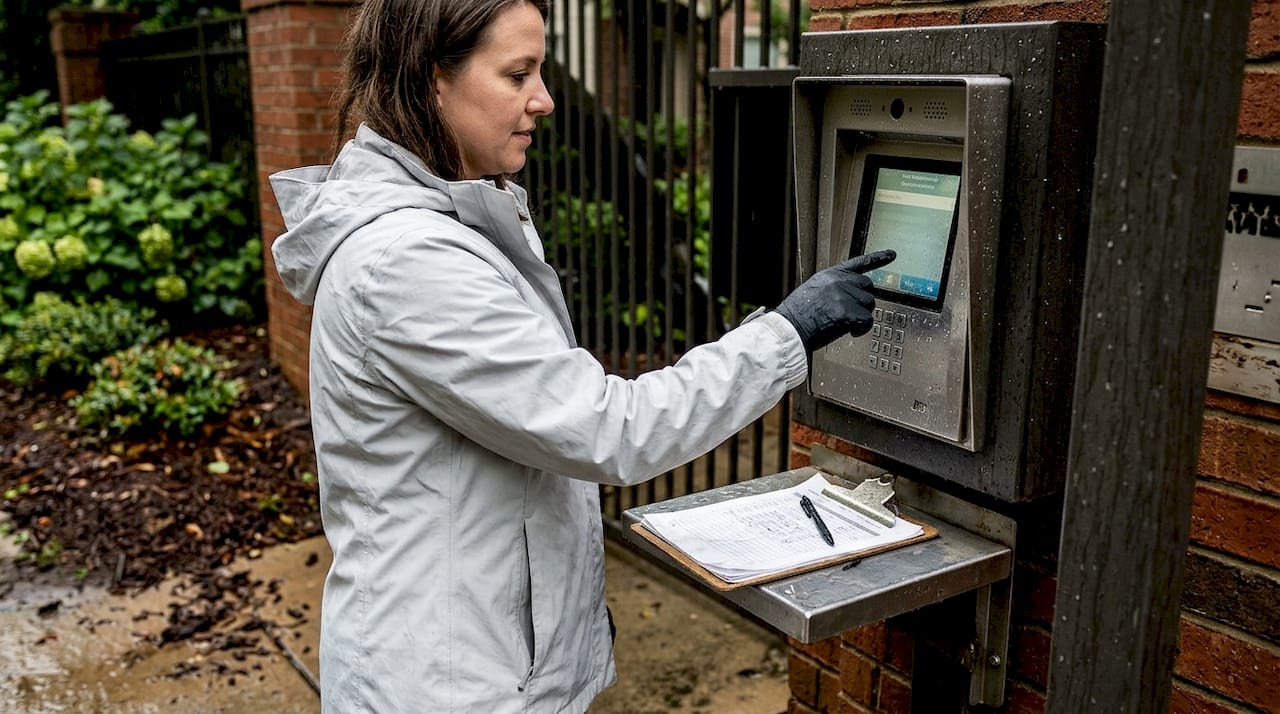
Atlanta experiences severe weather regularly, and power outages can knock out traditional wired access systems entirely. Cellular-based access control systems stay operational even when the power grid fails, which is a critical advantage in a city where storms can leave neighborhoods dark for hours.
Here’s how traditional and modern access systems compare:
| Feature | Traditional system | Modern cloud or cellular system |
|---|---|---|
| Power dependency | Wired, fails in outages | Cellular backup keeps it running |
| Remote management | Requires on-site access | Managed from any device, anywhere |
| Visitor verification | Manual log or intercom | Video verification with digital records |
| Resident access method | Key fob or PIN only | Mobile app, biometric, or LPR |
| Audit trail | Paper or basic log | Cloud-stored, searchable history |
The most capable modern systems include:
- License plate recognition (LPR): Automatically logs and verifies vehicles without requiring residents to stop
- Mobile app access: Residents open gates from their phones, reducing lost fob issues
- Biometric entry: Fingerprint or facial recognition for high-security zones within the community
- Telephone entry systems: Guests call residents directly for access, with a digital record created
- Visitor pre-registration: Residents approve guests in advance, reducing gate congestion and unauthorized entry
For a deeper look at how these systems are installed and configured, access control gate systems provide a useful technical reference.
Pro Tip: Always build a manual override plan into your access control setup. If your cellular system goes down during an extended outage, your trained security personnel need a clear protocol for managing entry without technology.
The human factor: Why professional guards matter
Technology is only as effective as the people monitoring and responding to it. A camera that records a break-in is useful for prosecution. A guard who prevents it is invaluable. That’s the core argument for professional security personnel in any serious gated community program.
Consider communities like Country Club of the South in Johns Creek, which operates 24/7 manned gates funded through HOA dues. The visible presence of a uniformed guard at the entrance changes behavior. Opportunistic criminals move on. Residents feel accountable. Visitors know they’re being observed.
“Human guards are essential for exercising judgment in situations that technology simply cannot handle. Integrating patrols with surveillance and running regular assessments is what separates a real security program from a security theater.” — Gated community security guide
What guards do that technology cannot:
- Recognize and respond to tailgating in real time
- Conduct welfare checks and handle resident disputes
- Coordinate with emergency responders during incidents
- Adapt to unexpected situations that fall outside programmed parameters
- Provide a visible deterrent that cameras and signs simply don’t replicate
For a broader look at what manned security roles involve operationally, the scope is wider than most residents expect. Guards aren’t just watching a screen. They’re making real-time decisions that protect your community.
The value of manned gates and roaming patrols is especially high in Atlanta, where local knowledge matters. A guard who knows the community’s layout, resident vehicles, and typical patterns spots anomalies faster than any algorithm.
Preparing for edge cases: Tailgating, storms, and emergency access
Every security plan looks good on paper until it meets a real-world edge case. In Atlanta, those edge cases are predictable enough to plan for, but serious enough to cause real harm if ignored.
In 2024, storms left 690,000 people without power across the region. For gated communities running wired-only access systems, that meant gates that wouldn’t open or couldn’t be secured. Emergency responders were delayed. Residents were locked in or out. The communities that handled it best had backup systems and trained staff who knew exactly what to do.
Here are the most common edge cases your security plan must address:
- Tailgating: A vehicle follows an authorized car through the gate without scanning. Guards and camera-based detection are the primary countermeasures.
- Power outages: Wired systems fail. Cellular backup or battery-powered gates keep access controlled during storms.
- Visitor management failures: Unregistered guests, delivery drivers, and contractors create entry ambiguity. Pre-registration systems and guard verification close this gap.
- Emergency responder access: Fire trucks and ambulances need immediate entry. Knox boxes, override codes, and guard protocols must be in place and tested.
- Resident lockouts: Lost fobs or app failures during off-hours require a clear escalation path to on-call staff.
Pro Tip: Run a tabletop drill twice a year with your property management team and security provider. Walk through each edge case scenario and identify exactly who does what. Gaps become obvious fast, and fixing them on paper is far cheaper than fixing them during an incident.
For storm-resilient security planning, the key is redundancy. Never let a single point of failure take down your entire access system. Layer your technology the same way you layer your overall security strategy.
How K-Lock can elevate your community’s security
Understanding the theory of layered security is one thing. Building it in your community is another. That’s where K-Lock Security comes in.
K-Lock works with Atlanta’s gated communities to design and implement security programs that go well beyond the gate. From storm-resilient access control and professional guard deployment to roving patrols and visitor management protocols, every solution is built around your community’s specific layout, resident profile, and risk exposure. As Atlanta’s security experts, K-Lock brings local knowledge that national providers simply can’t match. Whether you need a full security overhaul or a targeted assessment of your current gaps, the team’s executive protection services and community security programs are designed to give you confidence that your residents are genuinely protected, not just reassured.
Frequently asked questions
Are gated communities actually safer than non-gated neighborhoods in Atlanta?
Gated communities experience up to 33% fewer burglaries than non-gated areas, but property crime still occurs, which is why layered security is essential rather than optional.
How can we prevent tailgating and unauthorized entry at our gate?
Combining attentive on-site guards, camera-based vehicle detection, and regular resident awareness programs is the most effective way to reduce tailgating risk at controlled entry points.
What makes storm-resilient access control important in Atlanta?
Atlanta storms cause frequent and extended power outages, so cellular-based access systems with battery backup ensure your gate remains operational and secure regardless of grid status.
How often should security procedures and technology in a gated community be reviewed?
Experts recommend annual security reviews at minimum, plus an immediate review after any security incident, to catch technology gaps and procedural weaknesses before they’re exploited.
